The Radical Agenda may utilize affiliate links for recommended books and resources. This means we may earn a small commission from clicks or purchases through those links at no cost to you. We only recommend products and services we believe in. All opinions shared are entirely our own. Thank you for supporting The Radical Agenda!
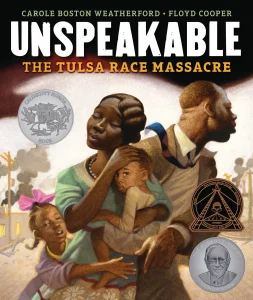
Unspeakable: The Tulsa Race Massacre

The Unspeakable Story
Unspeakable: The Tulsa Race Massacre by Carole Boston Weatherford and Floyd Cooper is the true and accurate retelling of the most destructive and devastating…well, massacre is the only fitting word for it…in American history. Sparked by a white woman alleging an assault by a Black teenage boy in an elevator, the entire town of Greenwood, Oklahoma was destroyed by white mob overnight.
I appreciate that this book was very factual. They did not shy away from the real story, nor did they attempt to gloss over any of it or make the ending “pretty” to make it palatable. The whole story is horrific, traumatic, and sad. Overnight, the entire town known by the moniker of “Black Wall Street,” was reduced to rubble and ash. This mob was provided weapons by the police officers in town (again, this book truly did not shy away from the facts).
This is not to say this book should be avoided. In fact, it should be read and discussed by everyone.
See also: The History of the KKK
Themes
Racism is Just Ugly
That’s it. It’s ugly. There is no avoiding how racism has shaped our country from the beginning, and this moment in history needs to be discussed, especially since it was so recent.
We have to face our country’s history of systemic racism in order to fix it. Think of it like this: if you get a wound and it is filled with dirt, you can’t just cover it up and pretend it doesn’t exist. The wound will fester and become infected, the infection will spread, and you can go into massive organ failure. The only way to actually heal is to go in and clean out that wound, otherwise it will keep coming back no matter how many antibiotics you throw at it.
The Tulsa Race Massacre did not just erupt randomly. It was the culmination of systemic violence within the culture.
Conversations
This has been one of my favorite books so far to discuss with my kids, especially my oldest. Our conversations related to this book have lasted far beyond just the main discussion we have after each book. The main focus has been on the effects of racism – how the belief that one people group is somehow “better” than another simply because of differences leads to this level of violence to maintain the perceived power dynamic. We talked about how our family rules of “kindness, dignity, and respect,” help guide healthy relationships and dynamics between people. When every person is treated with kindness, every person is treated with the dignity due them as a human, and differences are respected rather than “ranked,” the world is more peaceful and loving.
My oldest also was able to connect this story with other stories of people treated badly because of segregation, like Jackie Robinson and Georgia Gilmore.
Age Level
The recommended level is ages 8-12, and my soon-to-be-8-year-old was very engaged. My youngest (almost 5) listened and understood the overall concepts of the story, but was not yet able to participate much in the discussion of the themes and concepts. Note: I did reword a few phrases and pause to explain some definitions to make it easier for my youngest to understand and follow along.
Children’s Books for Pride Month
When Is Pride Month? (Just here for the books? Scroll down to see the list of children’s books for Pride Month, and don’t miss the link where you can easily order them all!) Pride Month is in June! On June 28, 1969, when police raided the Stonewall Inn (a...
Children’s Books for African American Music Month
June is African American Music Month! As usual, there are far too many influential Black musicians to name all of them in a single blog post, but these books will give a good start! Music is how the boys and I got started reading books about diverse Americans in the...
Children’s Books for Disability Pride Month
I have learned so much reading these children’s books for Disability Pride Month! I grew up learning about a few famous people with disabilities (like Ray Charles or Stevie Wonder, for my music lovers). But as the mission of showing all children that they belong...




0 Comments